Window Treatments = Art
During a recent client meeting, I launched into a full blown explanation (maybe a manifesto) on my love for window treatments…done right. Of course, people understand the basics—privacy, light filtering, and sun protection. But as a decorator, I see them differently. Beyond just functional, they’re visual anchors, adding warmth, color, texture, and scale. They soften hard window frames and act as large-scale art.
That’s why we never skip them. In fact, we don’t take on projects where clients won’t budget for window treatments. Yes, they’re expensive, but they’re essential and we often guide clients toward smart, affordable choices—but we insist they’re part of the plan. In Boston, we rely on Makkas Workroom, a professional workroom to the trade, that supports our design process and final results. Below, a few projects that show how a great workroom elevates the entire space.
A Textural Approach to Privacy and Proportion
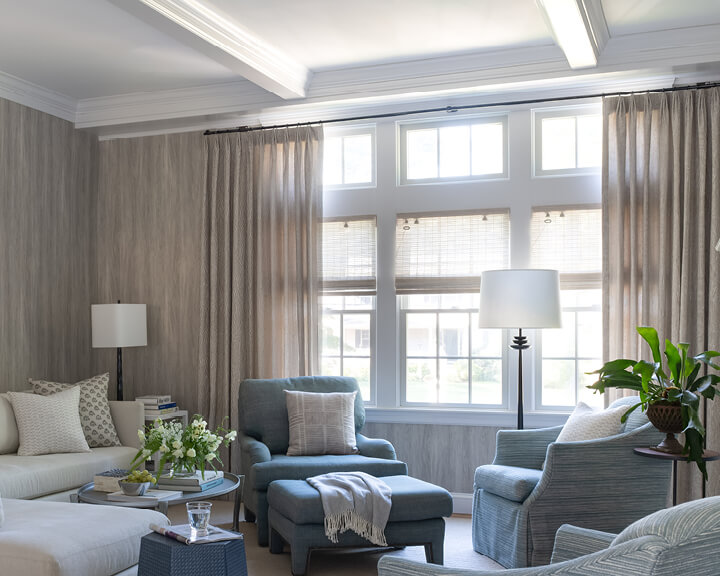
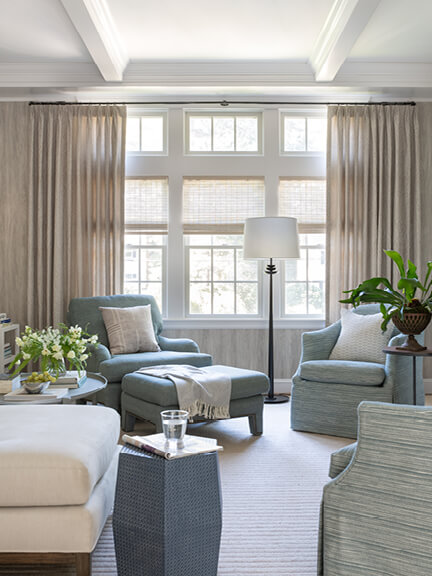
I’ve said it before: (some) architects forget about window treatments—they just keep adding windows. At that phase of the project, clients are always open to more natural light. But in this South Shore family room, sunlight overwhelmed the space, the old furniture faded, and the glare was blinding—while the windows were beautiful, they were just tooooo much. So we layered the treatments.
First, we added inside-mount woven Roman shades. Not quite white, but not a full-blown natural wood tone—they’re light and neutral. They filter the sun and soften the space during the day, and add privacy at night… no one likes living in a fishbowl. Hunter Douglas, but Makkas represents many lines and you can choose from a range of vendors.
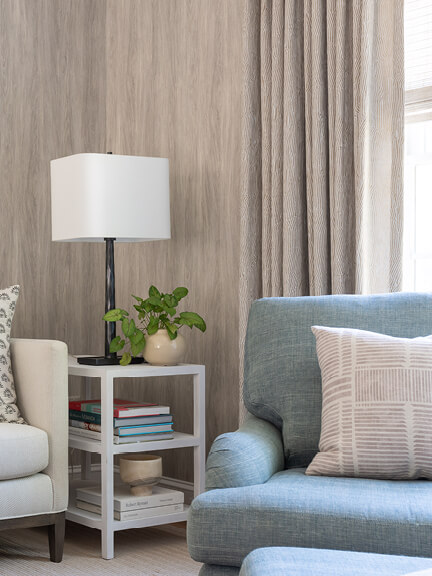
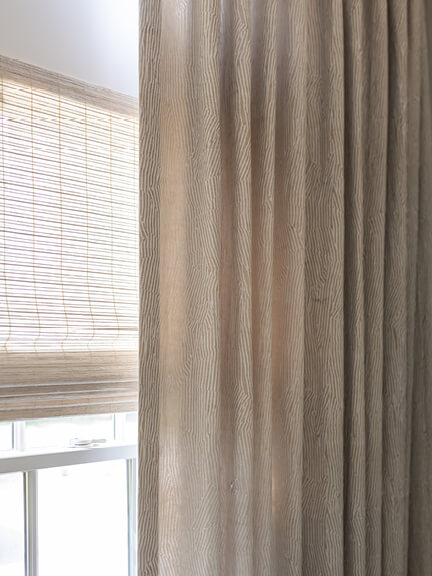
The ceilings were huge—almost uncomfortably tall. Enter our next add: custom tall linen drapery panels. The transom windows sat too high for shades, and the room needed more. These panels helped scale the space and brought the proportions back down to earth. They also add privacy at night and a touch of softness (great for noise—this is the TV room). The fabric, a neutral geometric print by Kelly Wearstler, offers a quiet pattern and acts like artwork, complementing the faux bois wallpaper from Nobilis. The matte black hardware was procured and installed by Makkas, and the drapes feature a classic pinched pleat detail.
Custom Shades and Drapery for a Brookline Classic
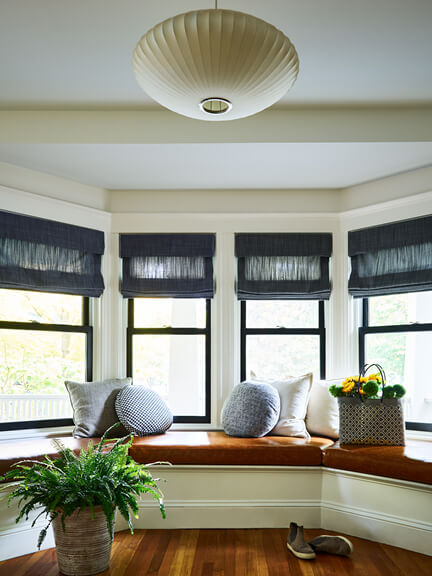
In this historic Brookline home, window treatments played a pivotal role. The homeowner—a textile artist—was especially attuned to all the fabrics we brought into each space, from furniture to rugs to pillows. And the window treatments were just as important. On the first floor, the original bay windows face a public park—great for the view, terrible for privacy. The inside-mount Roman shades pull in two directions: top-down and bottom-up. That allows the client to let in natural light without sharing it all with the neighborhood, a mechanism hand-crafted by the Makkas team.
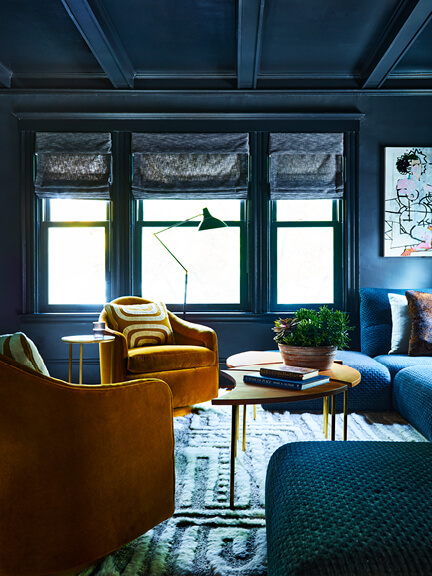
In the adjacent media room, more top-down, bottom-up shades—in a similar charcoal linen—coordinate with the foyer treatments. Cohesion is key. These shades filter light during the day and add privacy at night, and combine with the dark walls to create a true movie-theater vibe when it’s time for Netflix or a film.
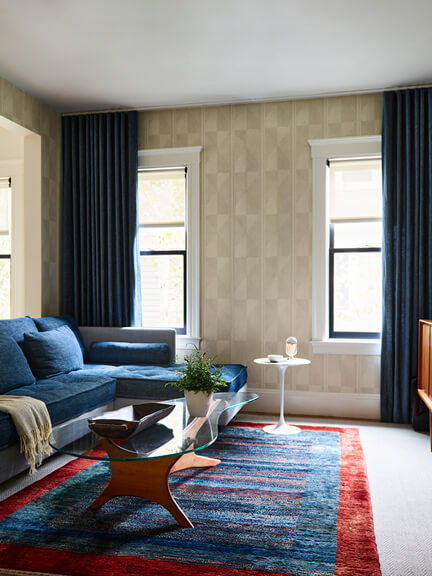
Lastly, in the family room, we used Spanish linen drapes that tie into the vintage area rug and the reupholstered sectional cushion—a denim-like blue. We opted for a modern install: ceiling-mounted hardware that disappears into the white ceiling. Ripple fold is simple and pretty much the only style that works cleanly with ceiling tracks. The drapes pool slightly at the floor—ideal for a room where urban neighbors sit just 20 feet away.
Layered Textiles for a Family-Friendly Basement
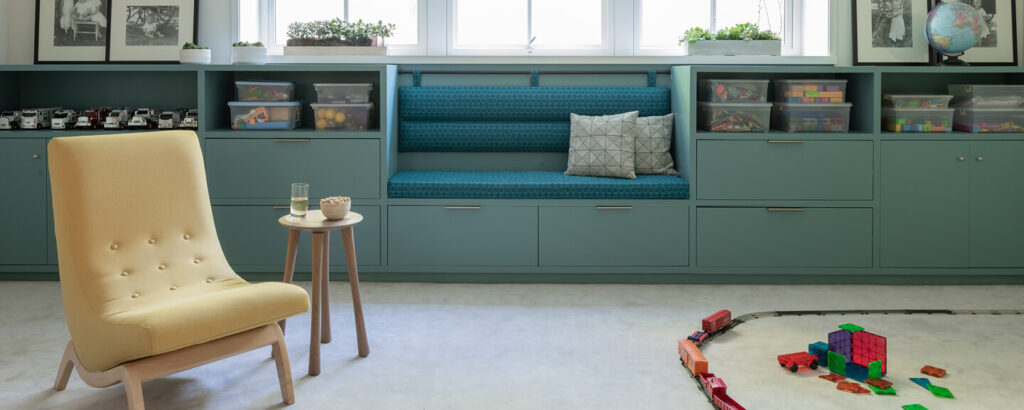
Lastly, Makkas helped at our modern home in Hingham, where we added window treatments to several basement rooms—the kids’ domain. In the open play area, they provided custom cushions at the bench—both a seat cushion and a back cushion installed on a simple black rod. Many (Broadway) kid performances go down in this space, and the adults need viewing spots.
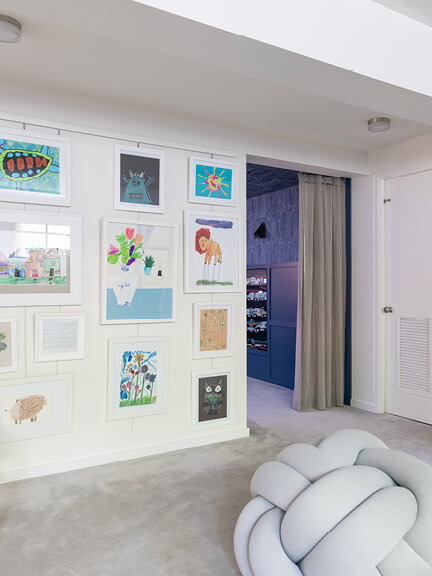
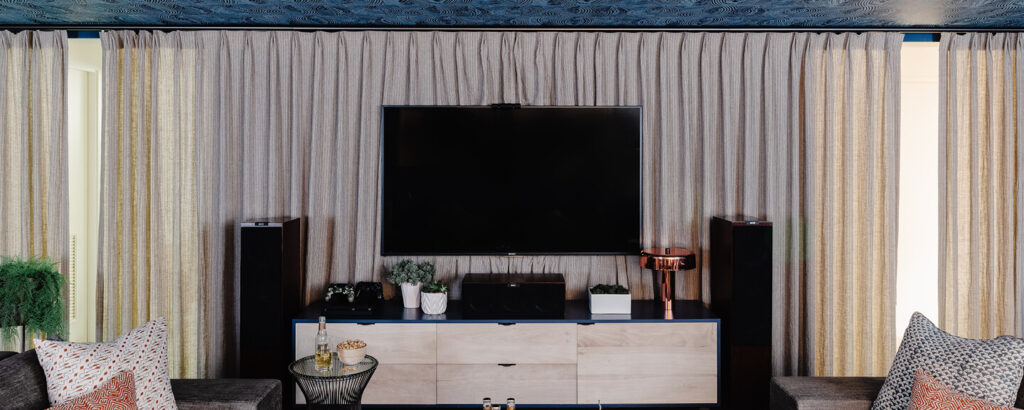
Leading to the adjacent media room, you can see the back side of drapery panels installed to help set the mood for movie night. A full wall of linen striped fabric from Schumacher covers the entire wall—hiding unsightly cords and power elements from the TV. It all closes cleanly when the kids are playing video games or it’s time for a family movie.
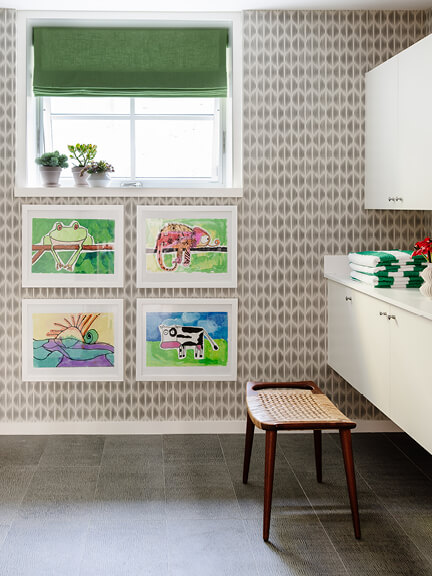
In the basement bath, a fun pop of color: we pulled a brilliant green from the art. Pierre Frey’s grass-colored linen was the perfect match for a Roman shade at the (surprisingly large) basement window—again, balancing light and privacy.
Window Treatments | Quietly Elevate a Room
We turn to trusted collaborators when it’s time to add softness, privacy, and polish—and for years, Makkas has been our go-to. Their custom work shows up all over our projects: crisp Roman shades, tailored cushions, full-height drapery, and the kind of finishing touches that quietly elevate a room. In older homes and new builds alike, these are the kinds of details that matter. See more in how we make a house a home or learn about our interior decorator services.
Workroom Wisdom
After years of partnering with Makkas Workroom, I wanted to share more about what makes their craftsmanship stand out. I asked Manny to walk through the details that separate good from great—the precision, tools, and experience that make custom window treatments worth every penny.
1. What’s the one detail in your work that most clients never notice—but makes all the difference in quality?
MANNY: One of the most overlooked—but absolutely critical—details in our work is the hardware. Clients may not always realize how much impact it has, but to us, it’s everything. The right piece brings warmth, function, and finish to the entire room. The wrong one throws the whole thing off. We’ve spent years building relationships with the best sources so every detail supports the full design vision.
2. Is there a part of the fabrication process that most people don’t see—but is critical?
MANNY: Cutting the fabric is one of the most important unseen parts of the process. It sets the tone for how the pattern will line up and how the final piece will look. We have one person in the workroom whose sole focus is cutting fabric. That level of precision makes all the difference.
3. Clients always mention The Shade Store—automated pricing, fast shipping, free measurements. How do you stand up for a boutique workroom in a world where mass-market brands want to take over? Can you speak to craftsmanship versus mass production?
MANNY: The difference comes down to experience and attention to detail. Mass-market brands like The Shade Store have speed and convenience, but they don’t have the depth of knowledge, craftsmanship, or the arsenal of tools and ideas that we bring. Their products look great, but they’re always a little off—too short, not functioning right. I’ll give them credit, they make a great Roman shade. But the difference is in the final touch. Their installers need to rush to the next job. We stay until it’s done right.
4. What’s the biggest misconception about having custom window treatments?
MANNY: Speed. People think custom window treatments take forever—but that’s not true. Yes, there are decisions to make—fabric, trim, lining—but our typical lead time is four to six weeks. And if you need it sooner for a party or event, we’ll get it done. The key is working with a workroom you trust. Lean on us to help you make smart choices that actually work.
5. How early should designers loop you into a project timeline?
MANNY: The earlier the better. Looping us in at the start helps avoid problems later—especially with home automation. We can flag things like hardware placement, ceiling recesses, crown molding conflicts, or where the wires and power need to go. A quick sit-down to review the drawings early on saves time, money, and headaches down the line.
6. Running a business: many designers are solo entrepreneurs, others have small teams. What’s your best piece of advice—design aside—for running a successful business, over time and through generations?
MANNY: The key is people. Take care of your employees, and they’ll take care of your business. It’s just as important as customer service. When you have the right team, the quality, responsiveness, and communication follow—and that’s what keeps clients coming back. That’s how you build something that lasts, generation to generation.
7. Custom work goes beyond fabric—it’s also about the tools and expertise behind it. What equipment do you use daily that clients might not think about?
MANNY: We’ve invested in equipment that helps us speed up the process. Stitching a ring on a Roman shade is very difficult, so we have a machine now that helps us stitch the rings. It just makes things more efficient. We also have a conveyor belt sewing machine. The conveyor belt, together with a machine, works in unison, so you have one long, consistent stitch versus a traditional sewing machine, where you can only stitch as long as your arms go. Those two tools help us create a better-looking, more consistent product.